
AI Agent Teams Accelerate Drug Discovery as Labs Deploy Multi-Agent Systems
Google and FutureHouse debut systems that generate hypotheses and analyze data autonomously, marking shift from AI tools to AI collaborators in research.
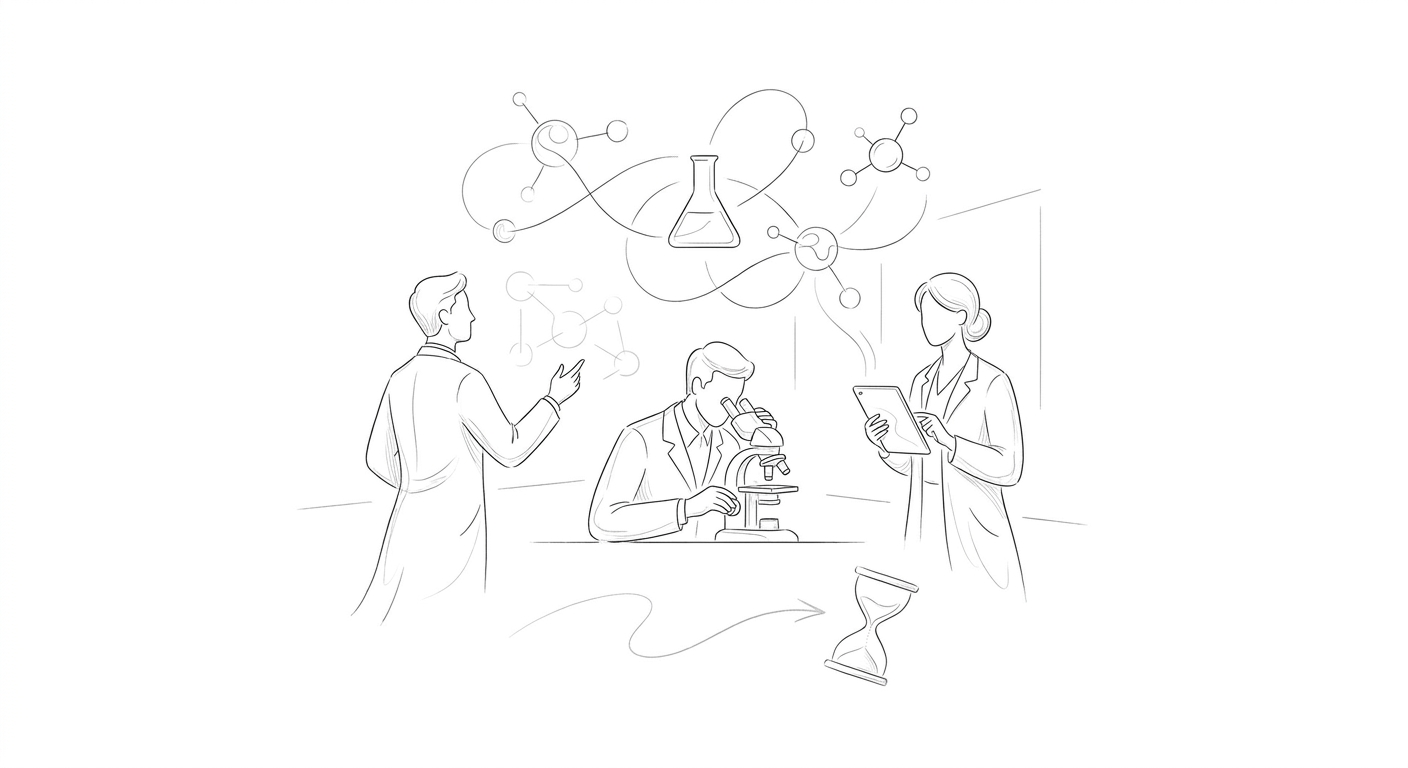
Two new artificial intelligence systems described in Nature are deploying teams of AI agents to autonomously develop hypotheses, propose experiments, and interpret results, signaling a fundamental shift in how laboratories conduct research.
Google's Co-Scientist and FutureHouse's Robin represent a departure from single-purpose AI tools toward multi-agent architectures that coordinate specialized tasks across the research pipeline. In one experiment, Co-Scientist identified candidate drugs to repurpose for acute myeloid leukemia treatment; human researchers selected five from the AI-generated list, three of which showed promise in preliminary cell studies. FutureHouse, a San Francisco nonprofit AI research lab, directed Robin to find treatments for dry age-related macular degeneration.
The systems mark what researchers describe as AI taking a "more-active role in the laboratory," moving beyond data analysis to participate in the conceptual stages of scientific inquiry. Both architectures distribute subtasks—literature review, experimental design, data interpretation—across multiple AI agents that communicate and synthesize findings.
(The Nature publications arrive as OpenAI posted a job listing for its Preparedness team seeking researchers to "support preparations for recursive self-improvement," with compensation ranging from $295,000 to $445,000, according to Business Insider. The listing signals industry attention to systems that could eventually improve their own capabilities, though the Co-Scientist and Robin systems do not exhibit self-modification features.)
The multi-agent approach reflects broader architectural trends in AI development, where specialized models coordinate rather than relying on monolithic systems. Google DeepMind's earlier AlphaFold solved protein folding through focused application; the new generation distributes reasoning across agent teams that mimic collaborative research dynamics.
Researchers at METR reported in March that the length of tasks frontier AI models can complete doubles approximately every seven months, a trajectory that has accelerated laboratory automation timelines and intensified competition for talent capable of designing agentic systems and reasoning about long-horizon failure modes.
Keywords
Sources
https://www.nature.com/articles/d41586-026-01596-4
Primary reporting on Co-Scientist and Robin systems with experimental results from acute myeloid leukemia drug repurposing studies
https://letsdatascience.com/news/openai-posts-job-to-prepare-for-self-training-ai-8d180686
OpenAI hiring for recursive self-improvement research signals industry focus on advanced AI capabilities and safety talent competition
https://www.amacad.org/daedalus/ai-science-what-is-the-future-of-discovery
Philosophical framing of transition from AI tools to autonomous scientists, emphasizing epistemic aims and conceptual challenges
https://www.networkworld.com/article/4174188/ai-reshapes-cybersecurity-workforce-priorities-as-it-teams-brace-for-new-risks.html
Workforce implications as AI penetration testing becomes top training priority amid concerns over agentic AI risks