
Allen Institute Unveils Simulation-Only Robot Training in Open-Source Push
Ai2's MolmoBot system trains robots entirely in virtual environments, outperforming physical-data models while releasing 230,000 scenes and 42 million annotations to the public.
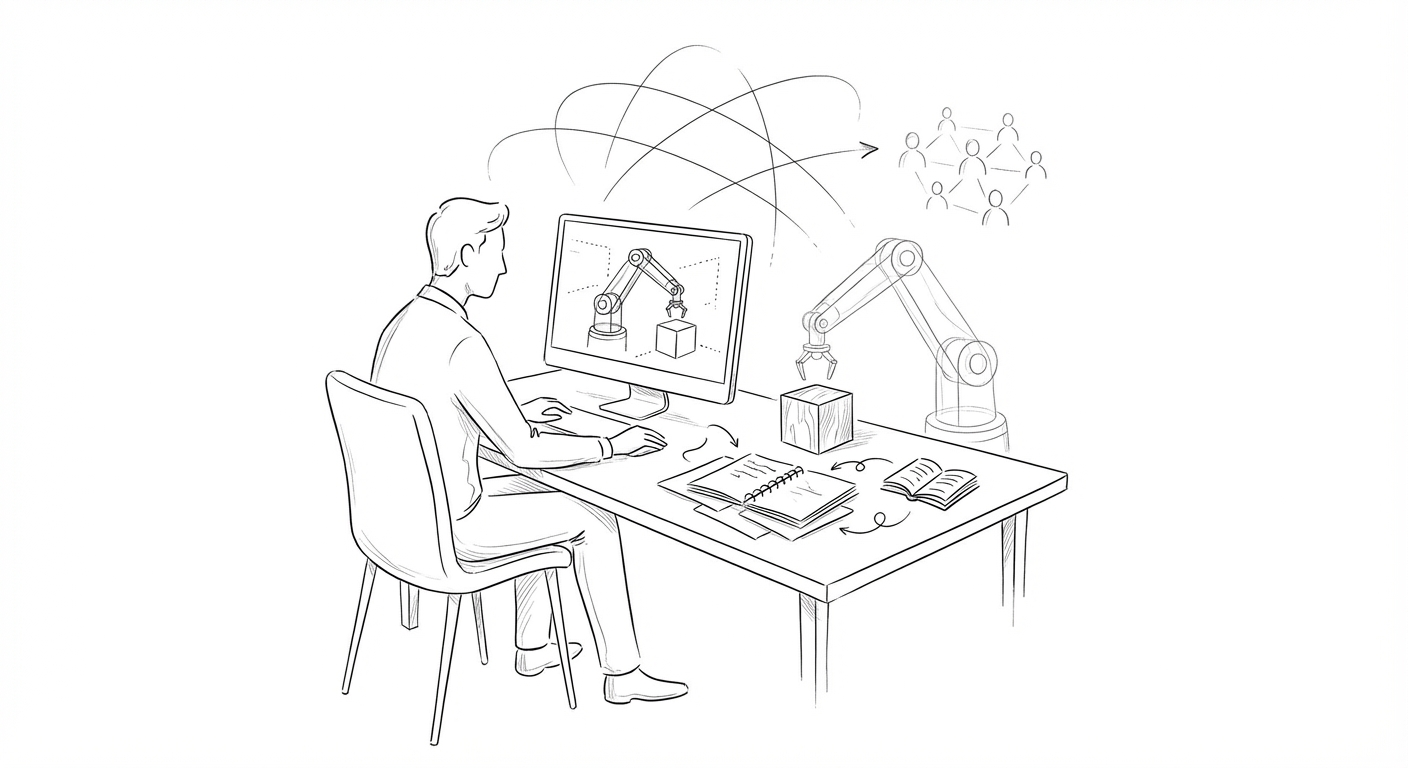
The Allen Institute for AI has released a suite of open-source robotics tools that train machines to manipulate objects using only simulated environments, eliminating the need for expensive physical demonstrations and marking a potential shift in how the field approaches embodied AI development.
The institute's MolmoBot system and accompanying MolmoSpaces dataset enable robots to perform manipulation tasks with what researchers call zero-shot transfer—moving directly from virtual training to real hardware without additional fine-tuning. In benchmark tests, the approach outperformed models trained on physical data when deployed on Franka FR3 and Rainbow Robotics arms.
MolmoSpaces includes more than 230,000 indoor scenes, 130,000 object models, and 42 million grasp annotations distributed across multiple simulator platforms. The institute has made all components fully open-source, including underlying code and assets designed for reproducibility across different robot embodiments.
The release arrives as the artificial intelligence industry grapples with competing philosophies around openness. Meta has championed open-source models as accelerants for technological progress, while companies including OpenAI and Anthropic have argued that releasing foundational code creates unacceptable safety risks. Meta's own AI development has faced internal turbulence, with the company reportedly delaying its Avocado model and weighing whether to license Google's Gemini after disappointing trial runs.
(Ai2, a research institute founded by Microsoft co-founder Paul Allen, operates independently from major commercial AI labs and has historically prioritized open research contributions in natural language processing and computer vision.)
The simulation-first approach could redirect research resources from data acquisition toward algorithmic innovation, particularly for manipulation tasks in indoor settings such as homes and offices. By building tools compatible with multiple simulators rather than proprietary systems, the institute is positioning the release as infrastructure for community-driven improvement in robotics research.
The move contrasts with the broader AI landscape, where capability races have intensified. Startup Tenzai recently demonstrated AI agents ranking in the top one percent of elite hacking competitions, prompting calls for restricted access to highly capable models. Meanwhile, advertising platforms have begun deploying agentic AI to automate entire campaign lifecycles, from planning through execution and optimization.
The robotics release reflects a strategic bet that lowering barriers to entry will accelerate progress more effectively than concentrating development within well-funded labs. Whether that thesis holds as manipulation tasks grow more complex—and as safety considerations around physical AI systems intensify—remains an open question for the field.
Keywords
Sources
https://mlq.ai/news/ai2-launches-open-source-tools-for-robots-trained-solely-in-virtual-environments/
Technical specifications of MolmoBot's benchmark performance and dataset scale, emphasizing shift from data acquisition to algorithms
https://nypost.com/2026/03/13/business/meta-delays-release-of-new-ai-weighs-licensing-googles-gemini-after-disappointing-trial-runs-report/
Meta's internal AI struggles and open-source philosophy debate, contrasting with Ai2's release approach
https://www.forbes.com/sites/thomasbrewster/2026/03/17/ai-beat-most-humans-in-elite-hacking-competitions/
AI capability acceleration in offensive security, raising questions about access restrictions for powerful models
https://www.mediapost.com/publications/article/413501/ai-will-soon-run-an-entire-ad-campaign.html?edition=141938
Agentic AI automating complete workflows in advertising, illustrating broader trend toward autonomous systems