
Chinese Agritech Startup Nuwa Bets on 'Data Flywheel' to Challenge U.S. Robotics Hype
As American investors pour capital into robotics, a Chinese livestock automation firm is quietly building a full-stack AI platform—raising questions about hardware margins and geopolitical advantage.
A Chinese agricultural technology company is positioning itself to export not just robots, but entire digital operating systems for livestock farms, even as American venture capital grows skeptical of robotics hardware economics.
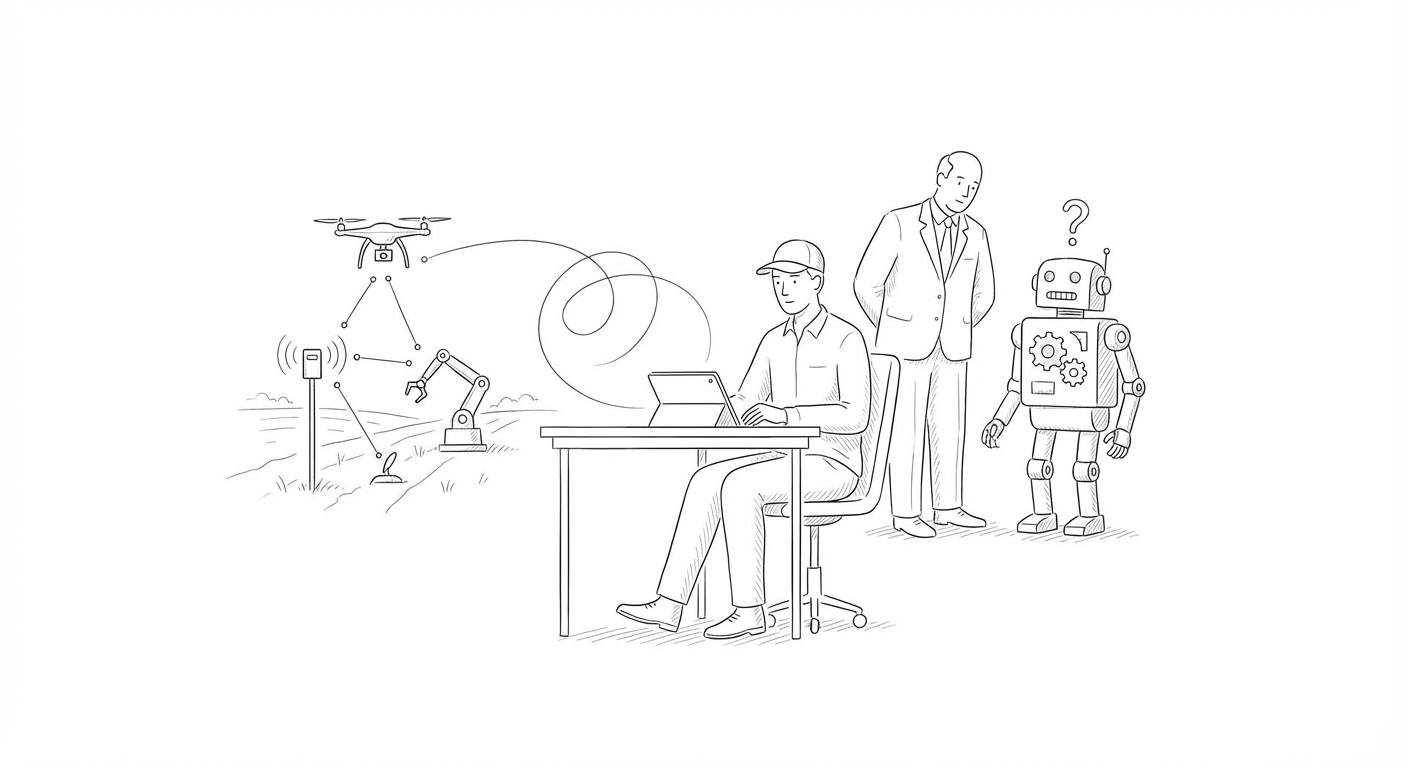
Nuwa Agricultural Technology recently showcased its autonomous livestock management platform, which combines on-farm robots with cloud-based analytics and health monitoring. The company's strategy centers on what it calls a "data flywheel"—a self-reinforcing loop in which deployed robots generate operational data that improves AI algorithms, which in turn enhances robot performance and attracts more customers.
According to Nuwa founder Andy Luo, the focus is system-level transformation rather than isolated automation. "Our goal is not just to automate tasks, but to build an intelligent operating system for livestock farms," Luo said. The three-layer architecture includes autonomous hardware, subscription-based software analytics, and continuous feedback loops for farm decision-making.
The approach contrasts sharply with the cautious mood among U.S. investors, who are increasingly wary of robotics timelines and capital intensity. One venture analyst compared the current robotics wave to autonomous vehicles, noting that after years of heavy investment, "you can count the number of players still in the race on one hand." The analyst argued that costly hardware and thin margins—especially against Chinese manufacturing scale—make the underlying AI models a safer bet than the machines themselves.
(Nuwa's announcement comes amid broader turbulence in the AI sector, including a historic Pentagon designation of Anthropic as a supply chain risk and ongoing legal battles over government AI policy. The U.S. Department of Defense declared Anthropic a risk "effective immediately," marking the first such action against an American company, while CEO Dario Amodei vowed to challenge the move in court.)
China has long held structural advantages in hardware production, with lower manufacturing costs and established supply chains for robotics components. American hardware startups face pressure to demonstrate not only technical capability but sustainable unit economics in a market where Chinese competitors can often undercut on price. The tension has intensified as Washington tightens export controls on AI chips and seeks to insulate domestic supply chains from foreign dependencies.
Meanwhile, U.S. tech giants are doubling down on custom silicon to reduce reliance on third-party chip suppliers. Meta recently unveiled four in-house AI accelerators designed for internal data center use, while Hewlett Packard Enterprise reported strong demand for AI networking gear despite memory shortages. The moves reflect a broader industry shift toward vertical integration and supply chain diversification.
Keywords
Sources
https://www.openpr.com/news/4417029/from-times-square-to-silicon-valley-nuwa-agricultural
Details Nuwa's three-layer technology stack and data flywheel strategy for livestock farm digitization
https://www.forbes.com/sites/the-prototype/2026/03/07/startup-loft-orbital-is-launching-ai-powered-satellites-this-fall/
Venture investor warns robotics is overhyped, citing high costs and China's manufacturing edge over U.S. hardware startups
https://zamin.uz/en/technology/193736-new-rules-developed-for-ai-development.html
Reports Pentagon-Anthropic conflict and government sluggishness threatening national AI security posture
https://www.cnbc.com/2026/03/11/meta-ai-mtia-chip-data-center.html
Covers Meta's custom chip rollout as tech giants pursue silicon independence and supply diversity