Congress Cedes AI Regulation to States as Federal Gridlock Deepens
A Silicon Valley congressman says Congress lacks capacity to regulate AI, while states and local governments deploy the technology across public services with minimal oversight.
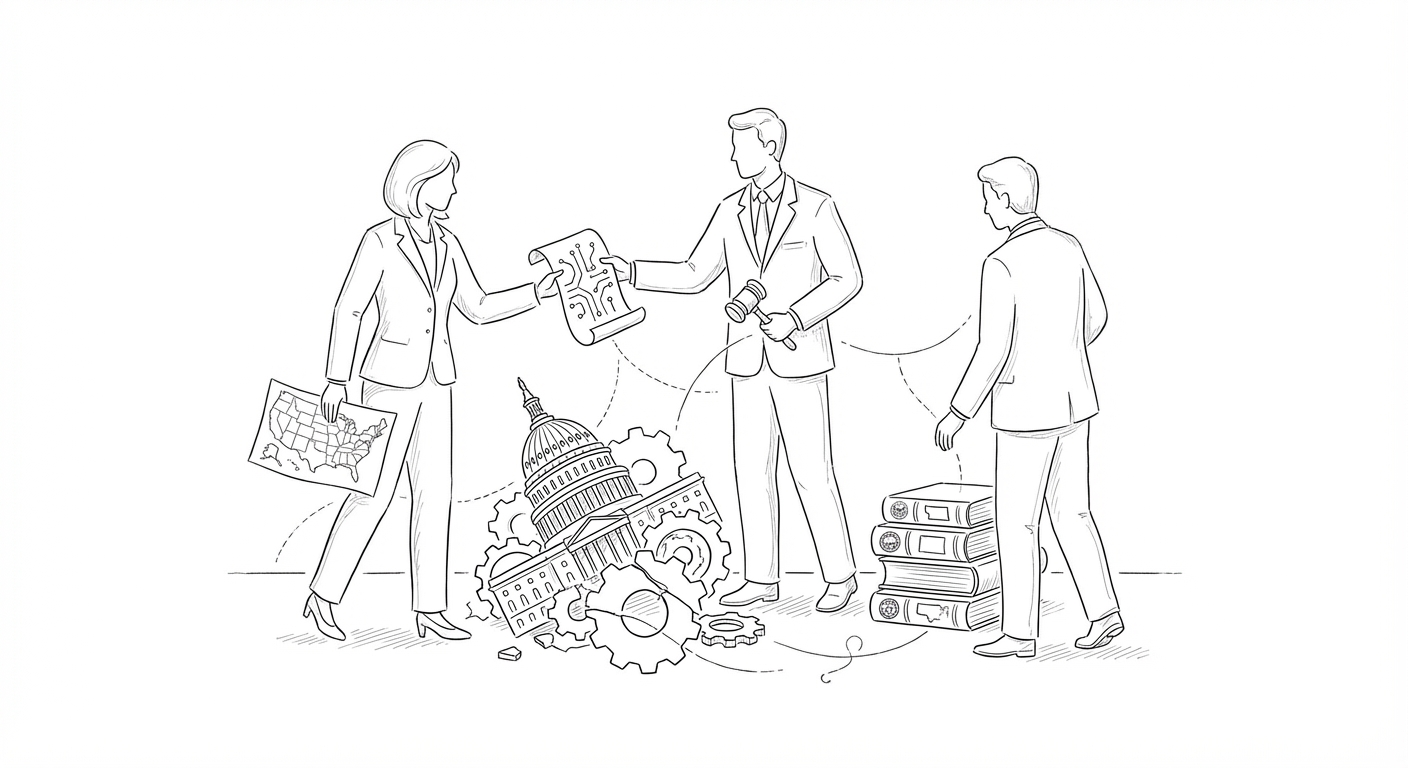
The federal government's inability to regulate artificial intelligence is pushing policy authority to states and municipalities, even as AI systems proliferate across public administration with little coordination or safeguards.
Rep. Sam Liccardo, representing parts of Silicon Valley, told The Washington Post in an exclusive interview that Congress is "incapable of regulating AI," a stark assessment from a lawmaker at the heart of the technology industry. Liccardo outlined proposals for bridging the regulatory gap, though he did not detail specific mechanisms.
The vacuum has emboldened state action. Utah became the first state to allow AI-driven prescription refills in early 2026, overseen by its Office of AI Policy, which launched in July 2024. Margaret Busse, executive director of the Utah Department of Commerce, said the office aims to "balance excitement about AI with public anxiety about potential pitfalls and consequences."
Local governments are deploying AI for translation services, permitting processes, and administrative tasks, driven by promises of efficiency but shadowed by concerns over job displacement. A 2026 paper by GovAI researcher Sam Manning identified clerks, administrative assistants, tax collectors, and receptionists as occupations with "high degrees of exposure and low capacity to adapt" to AI automation.
(The fragmented regulatory landscape comes as private-sector AI adoption accelerates. Companies are now tracking employee "token" usage—AI's unit of computational measurement—as automation platform Zapier and others monitor costs. Meanwhile, a California court temporarily allowed Perplexity AI's shopping agents to operate on Amazon, and new "agentic AI" platforms promise to automate entire advertising campaigns from planning through execution.)
The federal-state tension mirrors earlier technology policy battles over data privacy and content moderation, where congressional inaction ceded ground to California and other states. Unlike those domains, AI regulation involves critical infrastructure and public services, raising stakes for inconsistent standards across jurisdictions.
Congress has held numerous hearings on AI safety and competition since 2023 but has passed no comprehensive legislation. The absence of federal guardrails leaves states to experiment with varying approaches to algorithmic accountability, data governance, and workforce protections as AI reshapes government operations.
Keywords
Sources
https://www.washingtonpost.com/wp-intelligence/ai-tech-brief/2026/03/17/congress-is-losing-race-regulate-ai/
Exclusive interview with Rep. Liccardo on Congress's regulatory incapacity and proposed solutions for federal AI oversight gap
https://www.govtech.com/artificial-intelligence/ai-lets-state-and-local-governments-extend-their-reach
Utah's pioneering AI prescription platform and state/local deployment across services, balanced against job displacement fears
https://www.wsj.com/tech/ai/ai-tokens-productivity-d35c6bd8?gaa_at=eafs&gaa_n=AWEtsqcbCWcHavqtWBhfyCSFktekXEQLswhOF6j9S48xkelossmrRzceNwX9&gaa_ts=69ba0c72&gaa_sig=4O9DXZOUc5qrU1SLikVeTnJu4zmYI2682BVSr7-nmloc0T3QYn6USXxJnIJ6RzYD2wqHmeiyM5KS0PwQvkNEew%3D%3D
Corporate AI adoption metrics focus on token usage tracking as companies measure automation costs and productivity gains