Congressional AI Roundtable Turns Existential as Lawmakers Confront 'Destruction' Fears
A House subcommittee discussion on AI policy veered into anxiety over cybersecurity threats and existential risk, exposing deep uncertainty among legislators as federal action stalls.
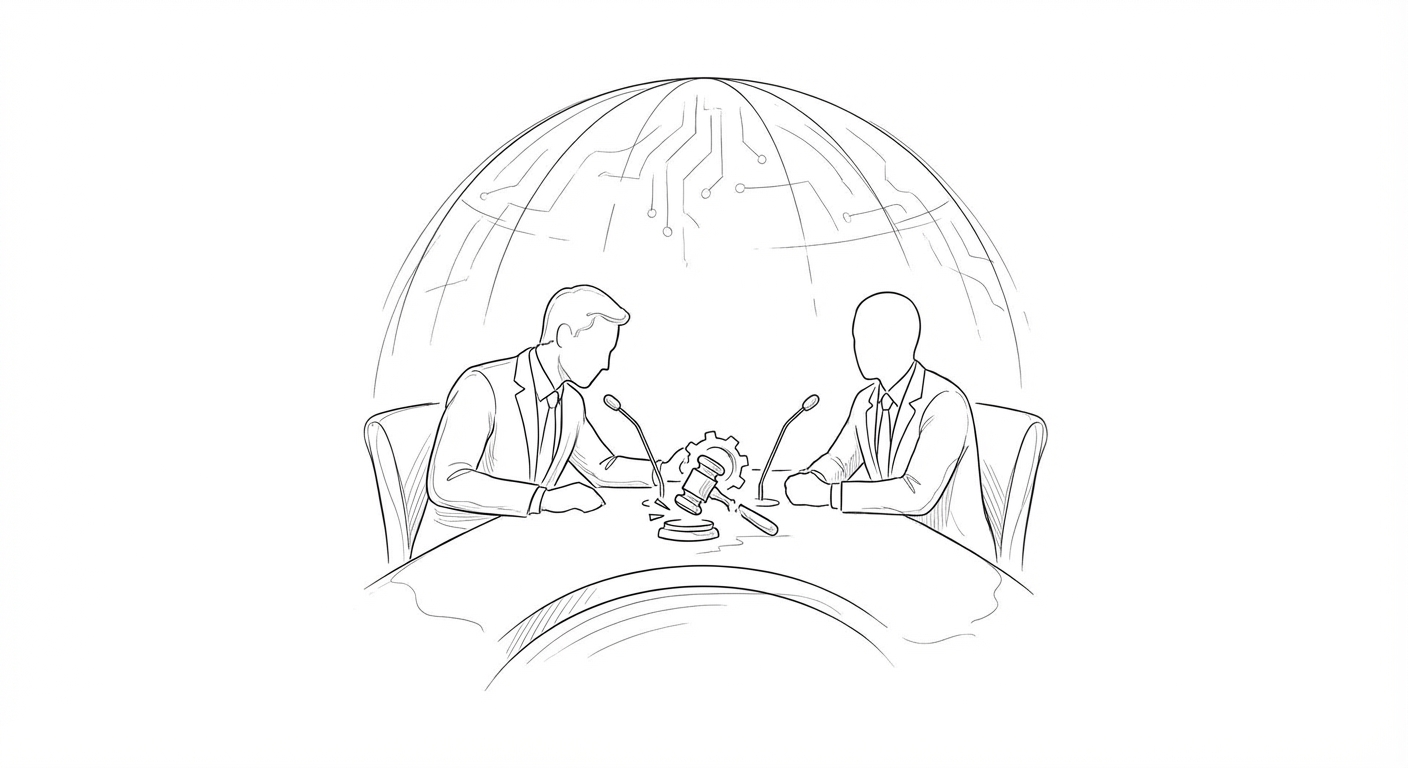
A congressional subcommittee roundtable on artificial intelligence devolved into a public airing of existential anxieties, with lawmakers openly questioning whether the technology's rapid evolution could lead to societal collapse.
Rep. Eli Crane, R-Ariz., a former Navy SEAL, asked panelists directly whether the AI race might be "simultaneously engineering our own destruction." The question reflected broader unease among legislators grappling with disclosures from firms like Anthropic, whose Mythos AI model reportedly possesses capabilities so potent the company is restricting access due to its apparent ability to bypass cybersecurity defenses at banks, government agencies, and major corporations.
Other lawmakers voiced narrower but equally urgent concerns. Rep. James Walkinshaw, D-Va., expressed alarm that federal workers may be using AI chatbots to handle sensitive government data. Rep. William Timmons, R-S.C., questioned whether AI-generated pornographic deepfakes should be criminalized. The discussion underscored a legislative body struggling to translate technical complexity into coherent policy.
Industry representatives urged caution. Mark Beall, president of government affairs at the AI Policy Network Inc. and a former Pentagon official, warned that congressional inaction risked ceding America's competitive edge on national security grounds. Robert Atkinson, founder of the Information Technology and Innovation Foundation, offered a more measured assessment: "I don't think it's going to kill us."
(The roundtable occurred as the Trump administration released a National Policy Framework for AI advocating federal preemption of state laws, a position that has intensified friction with states like California, Texas, and Colorado, which have enacted or are implementing their own AI regulations.)
The congressional anxiety contrasts sharply with the administration's posture. The White House framework, released in March, argues that training AI models on copyrighted material does not violate copyright laws and calls for a "minimally burdensome national standard" to override state-level rules. An executive order signed in December created an AI Litigation Task Force within the Justice Department to challenge state AI laws in federal court, conditioning federal broadband funding on states' willingness to avoid what the administration deems onerous regulation.
Meanwhile, a separate House Select Committee investigation detailed China's use of legal and illegal means to acquire frontier AI capabilities, including chip smuggling and model distillation. The report concluded that the U.S. and its allies still control key chokepoints but warned that leadership in AI remains a national security priority for both governments. A Stanford report noted the U.S.-China AI gap has narrowed to 2.7 percent, with Chinese models entering global top-ten rankings.
The roundtable's existential turn reflects a legislative body caught between industry pressure to avoid regulation, state-level activism filling the federal void, and mounting evidence that AI capabilities are advancing faster than governance structures can adapt. The gap between congressional angst and actionable policy remains wide.
Keywords
Sources
https://www.greenwichtime.com/news/politics/article/lawmakers-gathered-quietly-to-talk-about-ai-22211161.php
Focused on lawmakers' existential anxieties and Anthropic's Mythos model cybersecurity capabilities driving congressional alarm.
https://thenextweb.com/news/trump-ai-national-standard-preempt-state-regulation
Detailed Trump administration's National Policy Framework and executive order creating litigation task force to preempt state AI laws.
https://chinaselectcommittee.house.gov/media/press-releases/select-committee-investigation-reveals-china-s-history-of-ai-chip-smuggling-and-model-distillation
Highlighted House investigation into China's AI acquisition strategies and U.S.-China competition framing AI as national security priority.
https://m.theblockbeats.info/en/news/61982
Reported Stanford's 423-page AI report showing U.S.-China gap narrowing to 2.7% with Chinese models entering global rankings.