
Former Crypto Miners Capture $48 Billion Windfall in Rush to AI Infrastructure
Companies that once mined Bitcoin are repurposing power contracts to build AI data centers, attracting hyperscale clients and cheaper capital—but face construction risks.
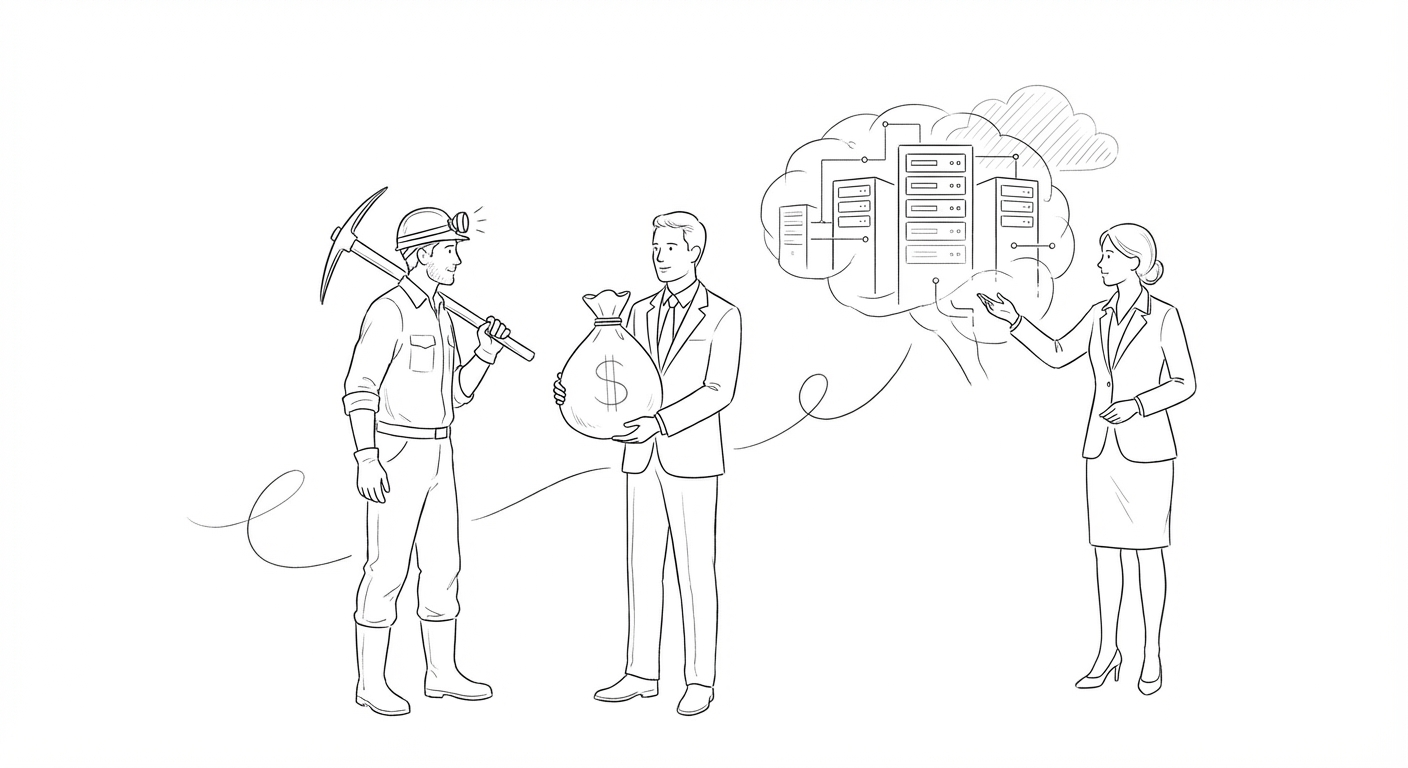
A cohort of companies that rode the cryptocurrency boom and bust has emerged as an unlikely force in artificial intelligence infrastructure, converting legacy utility agreements into a lucrative new business model. Former crypto-mining firms including TeraWulf, Applied Digital, Iren, Core Scientific, and Cipher Digital are now building AI-focused data centers, leveraging power contracts originally secured for blockchain operations to attract hyperscale tenants and institutional financing.
The transformation has been swift and financially dramatic. Eleven leading firms in this category saw their combined market capitalization surge from approximately $2.1 billion in late 2022 to roughly $48.5 billion by early April 2026, according to Bloomberg reporting. The revaluation reflects investor enthusiasm for AI infrastructure assets, particularly those with secured access to electrical capacity—a resource that has become a critical bottleneck as training and inference workloads expand.
Yet the pivot carries substantial execution risk. Analysts warn that companies face complex construction timelines, potential contractual penalties with utilities, and grid constraints that could derail projects or force renegotiation of power agreements. The transition from cryptocurrency mining, which requires relatively simple rack-and-stack hardware deployments, to AI data centers, which demand sophisticated cooling, networking, and compliance infrastructure, represents a significant operational leap.
(The shift coincides with broader industry trends in which access to reliable, low-cost electricity has become as strategically important as semiconductor supply chains, reshaping the competitive landscape for AI compute providers.)
The crypto-to-AI migration also highlights a structural advantage these firms possess over traditional data center operators: many secured long-term power purchase agreements during periods of lower energy costs and looser grid capacity, positioning them to offer competitive pricing to AI customers. That edge has attracted interest from hyperscale cloud providers seeking to expand compute footprints without navigating lengthy utility approval processes themselves.
The phenomenon underscores how infrastructure built for one speculative technology wave can be rapidly repurposed when market incentives shift. As AI workloads continue to grow, the question is whether these converted miners can execute on construction and operations at the scale and reliability enterprise clients demand—or whether their windfall will prove as volatile as the crypto markets they left behind.
Keywords
Sources
https://letsdatascience.com/news/former-crypto-miners-pivot-to-ai-data-centers-8b02943e
Highlights market cap surge from $2.1B to $48.5B and execution risks including construction complexity and grid constraints.
https://www.businessinsider.com/meta-superintelligence-labs-taps-leader-for-hardware-role-2026-4
Reports Meta's hardware expansion under MSL and vision for personalized AI agents across device constellations.
https://markets.ft.com/data/announce/detail?dockey=600-202604020001CANADANWCANADAPR_C1950-1
Covers IBM-Arm collaboration on dual-architecture hardware for enterprise AI workloads with Telum II and Spyre platforms.
https://letsdatascience.com/news/ai-industry-pursues-self-improving-research-systems-32187f56
Examines AI firms automating research workflows, with Anthropic claiming Claude writes 90% of code and OpenAI planning intern release.
https://www.marktechpost.com/2026/04/05/inside-the-creative-artificial-intelligence-ai-stack-where-human-vision-and-artificial-intelligence-meet-to-design-future-fashion/?amp
Explores AI integration in fashion design and manufacturing, including generative tools and digital twins for supply chain optimization.