
Healthcare Systems Urged to Adopt Capability-Based Monitoring for LLMs
Nature calls for new oversight framework as generalist AI models break assumptions underpinning traditional performance monitoring in clinical settings.
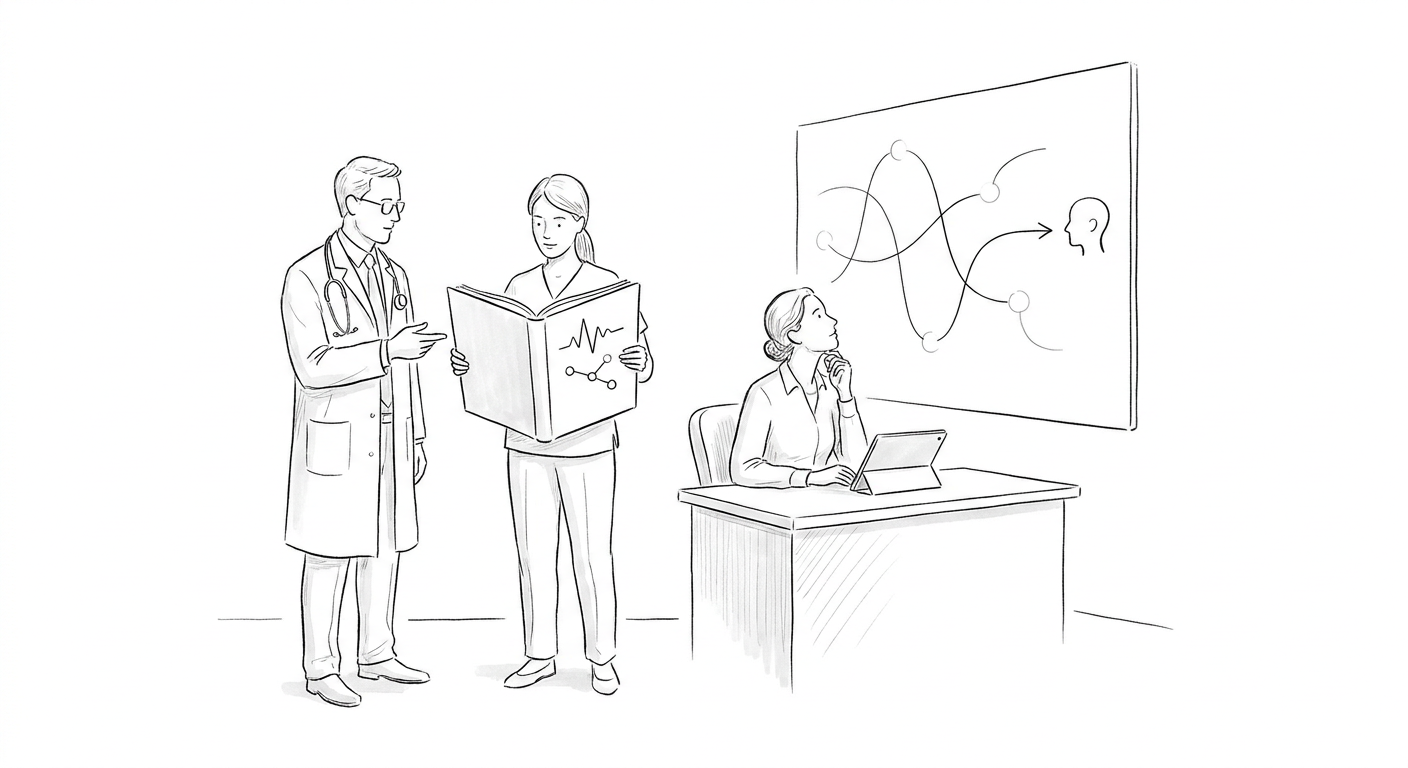
Healthcare systems, vendors, and regulators are being urged to adopt a fundamentally different approach to monitoring large language models deployed in clinical settings, as traditional oversight methods designed for narrow AI systems fail to address how generalist models are trained and used in practice.
A Nature article argues that the unit of monitoring must evolve from tasks to capabilities, tracking shared behaviors across contexts rather than performance on isolated clinical functions. The shift reflects a core challenge: in the LLM era, overfitting has migrated from model training to prompt, context, and workflow over-adaptation, rendering the traditional distinction between in-distribution and out-of-distribution clinical data far less predictive of actual performance.
Capability-based monitoring organizes oversight around shared internal capabilities that LLMs reuse across numerous downstream tasks, enabling cross-task detection of systemic weaknesses, long-tail errors, and emergent behaviors. The approach is described as both technically necessary and organizationally scalable, addressing the reality that modern LLMs are generalist systems whose overlapping capabilities span multiple clinical applications simultaneously.
The proposal arrives as millions of users consult generalist LLMs like ChatGPT, Claude, and Gemini for mental health guidance, despite these systems lacking the robust capabilities of human therapists. Specialized medical LLMs remain primarily in development and testing stages, while generic models are already being deployed for real-time cognitive support in areas ranging from anger management to clinical decision assistance.
Beyond healthcare, industries deploying generative AI are grappling with similar governance challenges. Insurance claims management has seen calls for periodic audits comparing AI results against human review to detect system drift, bias reinforcement, or missed issues. The American Bar Association has issued guidance treating generative AI as a form of nonlawyer assistance, requiring lawyers to maintain competence, supervise outputs, and protect confidentiality.
(Separate research published in Nature Biomedical Engineering addresses interpretability gaps in medical AI through class-association manifold learning, attempting to translate black-box models into interpretable global decision logic. The work reflects broader efforts to bridge the gap between AI performance and clinical explainability.)
The capability-based monitoring framework represents a departure from task-specific validation protocols that have governed medical AI deployment for decades. Traditional monitoring assumed models would degrade predictably when encountering data distributions different from training sets—an assumption that breaks down when models are designed to generalize across contexts and can be rapidly adapted through prompting rather than retraining.
Healthcare AI oversight has historically focused on validating performance for specific clinical tasks under controlled conditions, with post-deployment monitoring tracking performance on the same narrow function. That paradigm was built for models trained to perform single tasks like reading chest X-rays or predicting readmission risk, not for systems that can simultaneously assist with differential diagnosis, patient communication, documentation, and clinical research through natural language interaction.
Keywords
Sources
https://www.nature.com/articles/s41746-026-02740-0
Proposes capability-based monitoring framework as traditional task-focused oversight fails for generalist LLMs in healthcare
https://www.forbes.com/sites/lanceeliot/2026/05/16/anger-management-is-getting-mindfully-guided-via-generative-ai-such-as-chatgpt/
Highlights widespread use of generic LLMs for mental health guidance despite lack of therapist-level capabilities
https://insurancenewsnet.com/innarticle/genai-moving-to-the-forefront-of-claims-management
Emphasizes periodic audits and human oversight requirements as AI enters claims management workflows
https://www.nature.com/articles/s41551-026-01675-x
Addresses interpretability gaps in medical AI through class-association manifold learning techniques
https://www.washingtonpost.com/wp-intelligence/ai-tech-brief/2026/05/19/ai-tech-brief-ai-influence-machine/