
Industrial AI Stalls at Pilot Stage as Manufacturers Struggle to Scale Deployments
Despite doubling AI spending, 80% of industrial AI projects fail to reach production, exposing a widening gap between capital investment and operational execution.
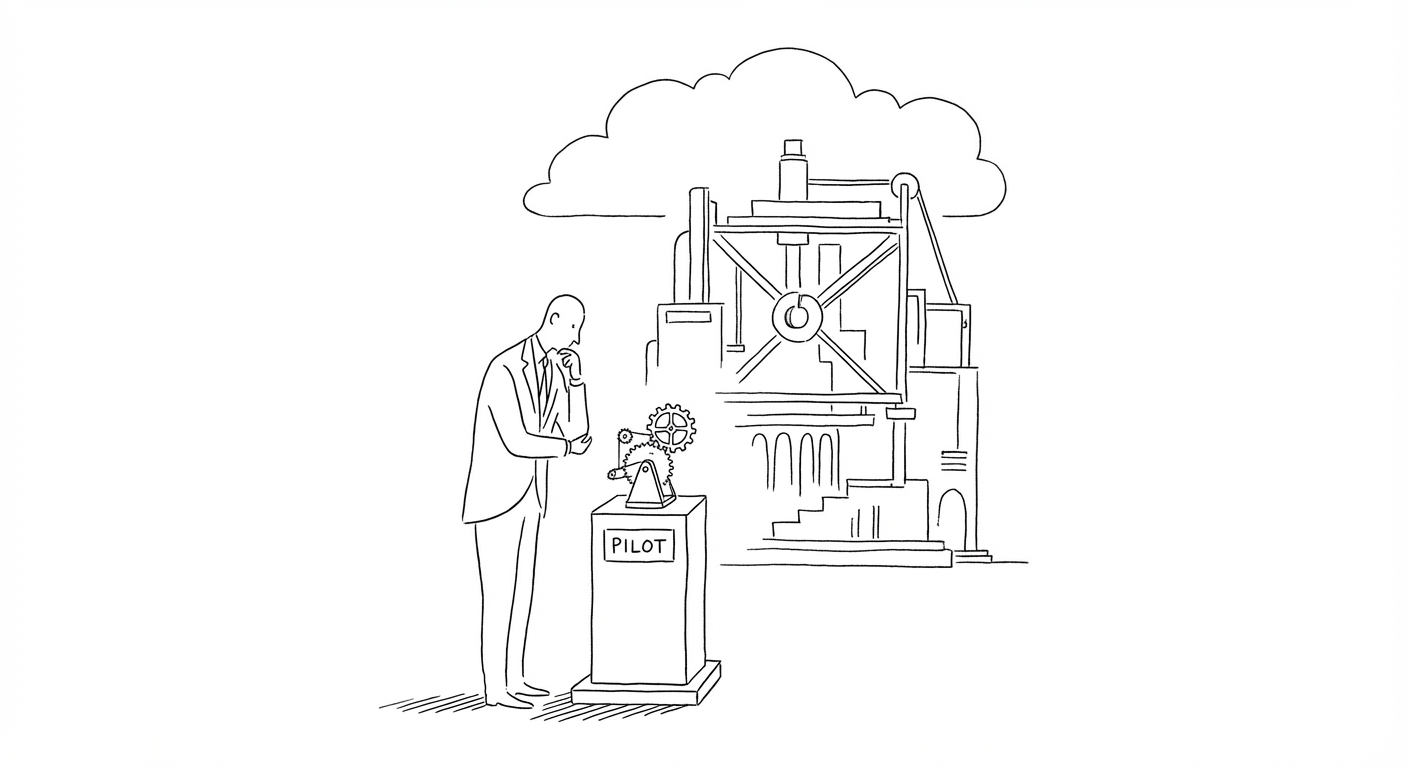
Manufacturing companies are pouring capital into artificial intelligence systems but failing to translate pilot projects into production-scale deployments, creating a bottleneck that threatens to undermine billions in technology investment.
Only 37 percent of manufacturers report feeling fully prepared to operationalize AI at scale, according to industry data tracked in early March. The failure rate is stark: 80 percent of industrial AI deployments never progress beyond pilot stage, even as manufacturers have doubled their AI spending budgets.
The pattern reveals a structural challenge distinct from the technology itself. Companies are successfully testing AI applications in safety monitoring, predictive maintenance, and workflow automation, but struggle when attempting to integrate these systems across facilities, supply chains, and legacy equipment networks.
Hyatt reported that its group sales teams achieved approximately 20 percent productivity gains after deploying AI tools, while Wyndham Hotels & Resorts said AI-powered call centers reduced labor costs for franchisees. These hospitality sector results stand in contrast to manufacturing outcomes, where operational complexity and physical infrastructure create higher barriers to scaling.
(The divergence between sectors suggests that AI deployment success correlates more strongly with organizational readiness and process redesign than with technology maturity. J.P. Morgan Asset Management noted that while nearly 90 percent of companies have invested in AI technology, fewer than 40 percent report measurable gains.)
Energy constraints are emerging as an additional limiting factor. Ruth Porat, president and chief investment officer of Google parent Alphabet, stated that the US may not be scaling energy supplies fast enough to meet AI expansion demands, specifically referencing the capacity needed to power growth in AI data centers. "We are not full throttle on energy," Porat said.
The industrial AI market is simultaneously producing technical breakthroughs in isolated applications. Fluke introduced AI features allowing technicians to generate work orders from voice commands and convert complex manuals into instant guidance. Researchers demonstrated AI-designed machines that adapt, recover from damage, and change shapes autonomously. Other teams used AI and 3D printing to create heat- and pressure-resistant materials for aerospace and defense applications.
Nvidia CEO Jensen Huang projected that the AI boom's next phase could bring $1 trillion in orders by year's end, describing the industry as still in its infancy. Yet the manufacturing sector's scaling difficulties suggest that hardware advances and capital availability do not automatically translate into operational transformation.
The gap between pilot success and production deployment reflects deeper organizational challenges. Companies must redesign workflows rather than simply automate existing tasks, integrate AI systems with decades-old equipment, and retrain workforces while maintaining operational continuity. Virginia officials debated scrapping tax breaks for data centers in mid-March, a proposal that could halt data center construction in the state, while Pennsylvania explored using abandoned mines and waste heat recycling to make massive new data centers more sustainable.
The manufacturing sector's AI scaling crisis arrives as the technology moves from experimental phase to infrastructure requirement across industries. The 80 percent failure rate at the pilot-to-production transition suggests that capital investment alone cannot overcome the human, organizational, and energy infrastructure challenges that determine whether AI delivers measurable returns or remains confined to isolated test environments.
Keywords
Sources
https://www.ien.com/artificial-intelligence/blog/22962993/the-new-apprenticeship-how-ai-is-preserving-the-wisdom-of-the-factory-floor
Focus on 80% failure rate of industrial AI reaching production and manufacturers doubling spending despite scaling struggles
https://www.hotelnewsresource.com/article140546.html
Hospitality sector contrast showing measurable productivity gains at Hyatt and Wyndham as AI moves beyond pilots
https://www.itnews.com.au/news/us-needs-more-energy-development-to-power-ai-google-president-says-624524
Energy infrastructure constraints as limiting factor, with Google's Porat warning US not scaling capacity fast enough
https://www.tipranks.com/news/openai-takes-aim-at-google-googl-and-microsoft-msft-with-stunning-superapp
Market dynamics context with Nvidia projecting $1 trillion orders and broader AI investment landscape