
Legacy ERP Systems Emerge as Bottleneck in Factory AI Deployments
Manufacturing executives confront a paradox: enterprise software designed to integrate operations now blocks the data flows AI requires, forcing costly infrastructure decisions.
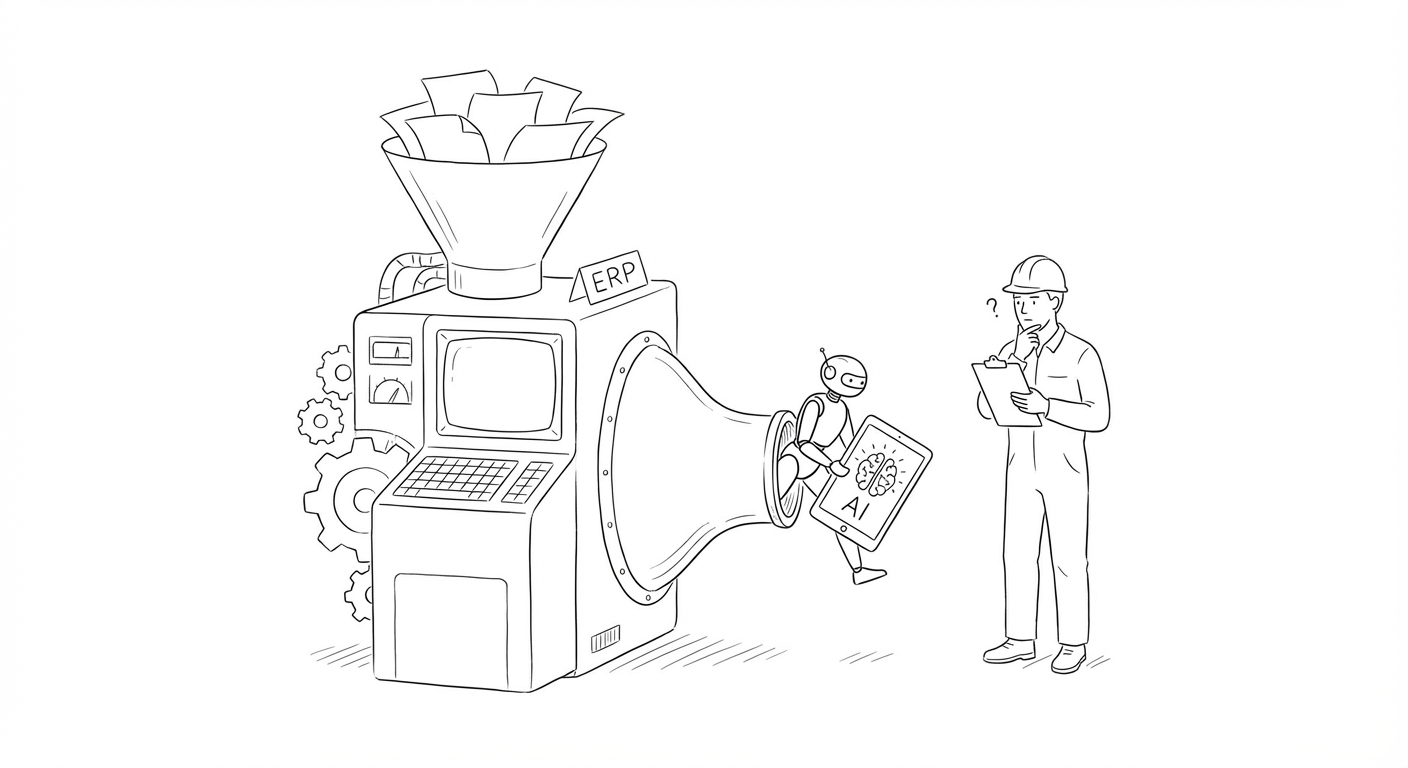
Enterprise resource planning systems, once the backbone of manufacturing operations, are increasingly viewed as obstacles to artificial intelligence adoption on factory floors, according to industry reports and deployment data from recent partnerships.
The friction centers on data architecture. Traditional ERP platforms were built to consolidate information within rigid schemas, but AI models require fluid access to raw sensor feeds, machine logs, and cross-functional datasets that legacy systems struggle to expose without extensive customization. Manufacturing facilities attempting AI pilots report that extracting usable data from decades-old ERP installations can consume more engineering resources than training the models themselves.
Stellantis and Palantir expanded their AI partnership in late March 2026, with the automaker explicitly citing the need to consolidate fragmented datasets and improve transparency across complex operations. The collaboration reflects a broader pattern: manufacturers are bypassing their ERP vendors and contracting directly with AI-native platforms to build parallel data layers.
Security concerns compound the technical challenges. Cybersecurity analysts warn that AI agents are already operating on devices with access to operational technology networks, even without formal authorization. A March 2026 study highlighted gaps in distinguishing AI agent actions from human activity, raising questions about access control in environments where ERP systems were designed assuming human operators.
(The Manufacturing Extension Partnership program, which has supported technology adoption at small and medium manufacturers, faced elimination in budget proposals released in April 2026, potentially removing a resource for facilities navigating these transitions.)
The infrastructure demands are reshaping industrial real estate. Vertiv announced a $50 million expansion of its Ohio cooling systems plant in March 2026 to meet data center demand, while a former General Motors site is under consideration for AI data center conversion. These investments signal that manufacturing AI may increasingly rely on centralized compute rather than edge deployments constrained by legacy on-premise systems.
Meanwhile, Apple is developing its own AI server chip, codenamed Baltra, expected to use TSMC's 3-nanometer process and deploy first in the company's security-focused cloud infrastructure. The move aims to reduce reliance on Nvidia GPUs and lower data center operating costs, illustrating how even consumer technology firms are building custom hardware to escape the economics of third-party AI infrastructure.
The labor dimension remains contentious. DHL Teamsters negotiated contract language in March 2026 explicitly prohibiting autonomous vehicles, a deal designed to prevent a strike involving thousands of workers. The clause underscores union concerns that AI deployments, often justified as productivity enhancements, carry workforce implications that existing enterprise systems were never designed to mediate.
Keywords
Sources
https://www.manufacturing.net/artificial-intelligence/article/22964443/why-your-erp-is-now-a-liability-not-an-asset
Frames ERP systems as liability blocking AI adoption; covers OT security gaps and AI agent risks in factory environments
https://technode.com/2026/04/09/apples-self-designed-ai-server-chip-baltra-may-be-manufactured-by-tsmc-using-3nm-n3e-process/
Details Apple's custom AI server chip strategy to reduce GPU dependence and data center costs
https://www.industryweek.com/the-economy/article/55370106/erasing-the-manufacturing-extension-partnership-and-is-a-chip-armageddon-looming
Highlights MEP program elimination and cross-functional AI productivity potential amid infrastructure uncertainty
https://www.cnbc.com/video/2026/04/09/meta-commits-to-spending-additional-21-billion-with-coreweave.html
Reports Meta's $21 billion CoreWeave commitment, illustrating scale of AI compute investment race