
Pentagon AI Infrastructure Market Hits $2 Billion as Startups Secure Classified Networks
Specialized firms deploy Retrieval Augmented Generation on Defense Department classified systems, filling gap between commercial LLMs and security requirements.
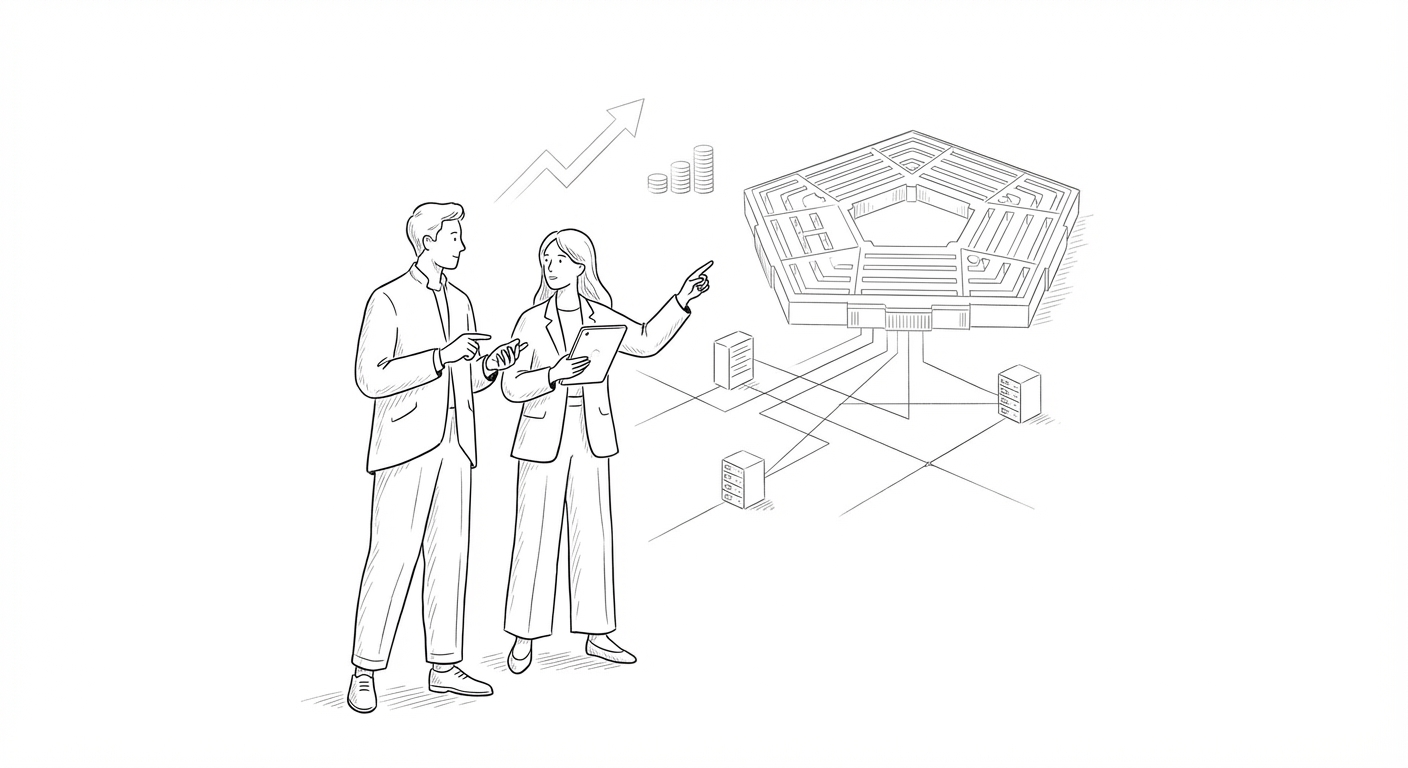
A cohort of AI infrastructure startups is carving out a $2 billion market by adapting commercial large language models for use on the Pentagon's most sensitive networks, solving a deployment challenge that has kept powerful AI tools largely off-limits to classified military operations.
The companies—including Ask Sage, Palantir, and Amazon Web Services—provide the secure software platforms and cloud services that allow models like Anthropic's Claude to operate on Defense Department classified networks without exposing sensitive data to commercial training pipelines or unsecured caches. Until a recent dispute, Claude was among the only LLMs approved for classified use, enabled by a 2024 infrastructure deal between Anthropic, Palantir, and AWS.
At the core of these deployments is a customized implementation of Retrieval Augmented Generation, or RAG, which allows models to pull information from uploaded documents and tailor responses without sending data back to the original model provider. Commercial LLMs use RAG when users upload files into chat windows, but those interactions carry risks: document contents may be used for future training or stored in temporary caches accessible to the provider. The infrastructure layer creates an airgap, isolating sensitive material while preserving the model's analytical capabilities.
"It's probably a $2 billion market right now," said Nicolas Chaillan, founder of Ask Sage, a platform used by thousands of Defense Department teams. The opportunity stems from an extreme version of a dilemma facing any organization deploying off-the-shelf LLMs on confidential data: how to harness the tools' power without inadvertently exposing information through the AI training process.
(These infrastructure providers receive less media attention than Google, xAI, OpenAI, and Anthropic, yet they function as essential intermediaries—akin to radios and runways that allow new warplanes to communicate with the rest of the military and land safely.)
The arrangement underscores a structural tension in AI adoption across government and enterprise: the most capable models are controlled by a handful of commercial vendors, but their standard deployment architectures are incompatible with strict data sovereignty and security requirements. Infrastructure specialists are positioning themselves as the connective tissue, translating commercial AI into formats that meet regulatory and operational constraints without requiring agencies to build models from scratch.
Keywords
Sources
https://www.aol.com/finance/startups-racing-ai-safe-pentagon-120000513.html
Detailed technical explanation of RAG customization and $2B market size estimate from Ask Sage founder
https://www.tipranks.com/news/company-announcements/g-mining-ventures-to-acquire-g2-goldfields-creating-tier-one-guyana-gold-hub-2
Unrelated financial news content; no relevant angle to Pentagon AI infrastructure story
https://www.bitget.com/amp/news/detail/12560605348275
Unrelated mining and data management content; no relevant angle to Pentagon AI infrastructure story
https://pitchbook.com/news/reports/q1-2026-european-venture-report
European venture capital trends; no direct coverage of Pentagon AI infrastructure market