
Tesla Taps Intel 14A for AI Chips as Inference Boom Reshapes Semiconductor Roadmaps
Elon Musk signals Tesla will use Intel's 14A process for AI silicon in its Terafab project, as Google splits TPU line and industry pivots to inference-optimized architectures.
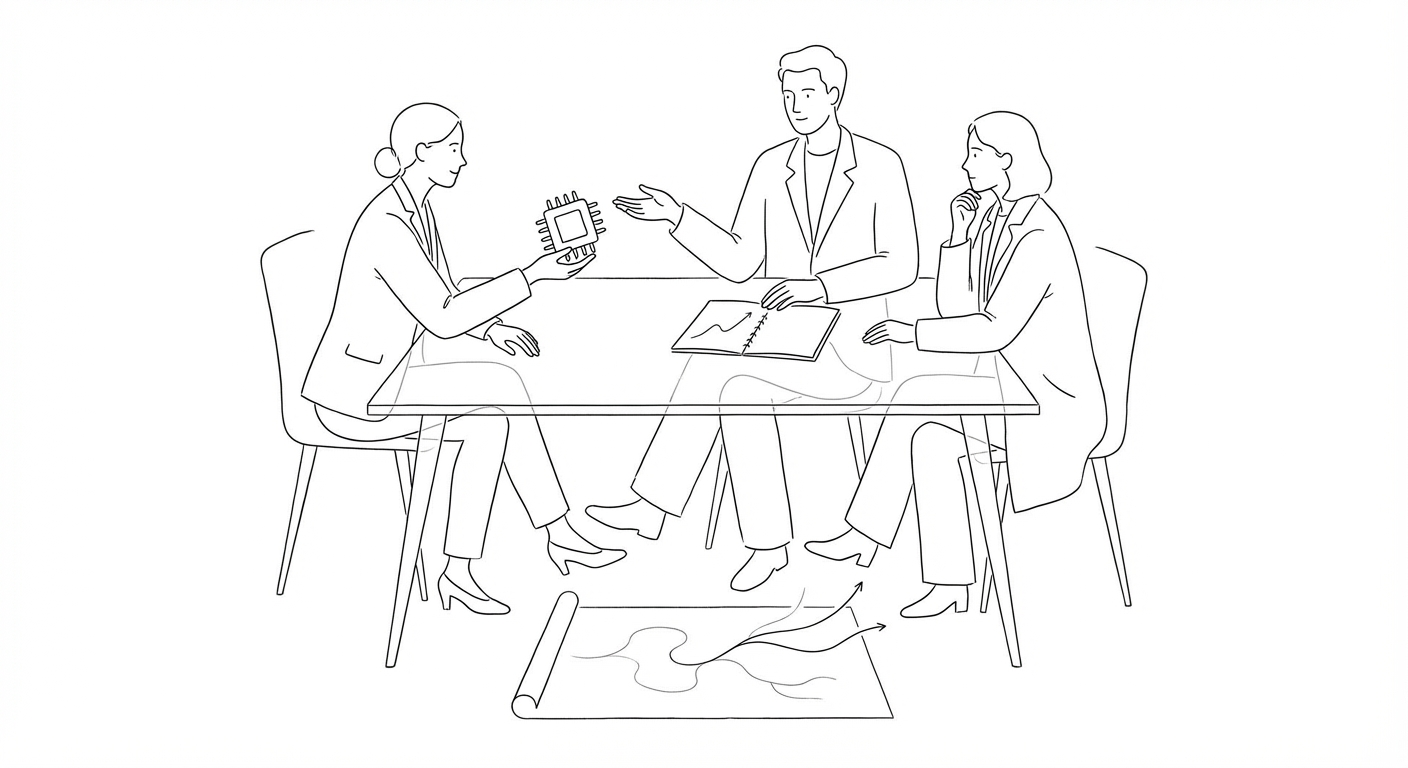
Tesla plans to manufacture AI chips using Intel's 14A process node as part of its multi-billion-dollar Terafab project, according to statements from Elon Musk indicating the technology will be "ready for prime time" when the facility scales up. The move represents a significant design win for Intel's advanced manufacturing process and signals Tesla's commitment to custom silicon for its autonomous driving and AI workloads.
The announcement comes as the semiconductor industry undergoes a fundamental architectural shift toward inference-optimized chips. Google this week unveiled two distinct eighth-generation tensor processing units—the TPU 8t for training and TPU 8i for inference—marking the first time the company has split its custom AI chip line into specialized architectures. "With the rise of AI agents, we determined the community would benefit from chips individually specialized to the needs of training and serving," wrote Amin Vahdat, Google's senior vice president and chief technologist for AI and infrastructure, in a blog post.
Google Cloud CEO Thomas Kurian described the decision as a "natural evolution" driven by the explosion in inference demand as businesses deploy AI agents capable of autonomous task execution. The TPU 8i features expanded high-bandwidth memory designed to address what Google calls the "memory wall"—the gap between processor calculation speed and data access rates that becomes critical for agent workloads requiring low-latency responses.
The strategic emphasis on inference reflects a broader market transition. Nvidia has repositioned its product roadmap around persistent, always-on AI workloads that operate continuously rather than waiting for user prompts. The company introduced new rack-level systems and CPUs specifically designed for agentic AI, alongside storage architectures aimed at removing bottlenecks in context memory and token throughput. "Inference is becoming the centerpiece of Nvidia's product strategy," according to industry analysis, as the company seeks to own the segment expected to generate the majority of long-term AI infrastructure demand.
Texas Instruments reported first-quarter 2026 revenue of $4.83 billion, up 19 percent year-on-year, with executives citing recovery in industrial and AI-related demand. The company is positioning itself as an enabler of "physical AI" systems that must sense, decide, and act reliably in real-world environments—a category that includes humanoid robots moving from research labs toward commercial pilots. German Aguirre, systems manager for robotics at TI, emphasized that intelligence "only matters if the system can sense, decide, and act in real time with high reliability."
(Google has been aggressively signing cloud infrastructure deals with AI developers, bundling TPU capacity with storage, Kubernetes, and database services. Earlier this month, Anthropic signed an agreement with Google and Broadcom for multiple gigawatts of TPU capacity, though the AI startup also secured up to 5 gigawatts from Amazon in a separate deal, underscoring the competitive intensity in cloud AI infrastructure.)
The chip architecture race has intensified as hyperscalers and automakers alike pursue custom silicon strategies to differentiate their AI capabilities and reduce dependence on merchant chip suppliers. Google's decision to create separate training and inference chips mirrors a pattern emerging across the industry, where workload specialization is unlocking efficiency gains that general-purpose accelerators cannot match. Intel's 14A process node, which Tesla intends to use, represents the chipmaker's bet on regaining manufacturing leadership through advanced packaging and transistor technologies.
Nvidia has dominated AI chip sales for training workloads, but the inference market remains more fragmented, with Google, Amazon, and now Tesla developing proprietary alternatives. The shift toward inference-heavy deployments also changes power and cooling requirements, as Thomas Kurian noted that Google designed its new chips "to be efficient in how much power they use because we felt that power efficiency would become a constraint as people continue to scale both training and inference."
Keywords
Sources
https://www.pcgamer.com/hardware/processors/tesla-to-use-intel-14a-for-ai-chips-as-musk-says-it-will-be-ready-for-prime-time-when-the-multi-billion-dollar-terafab-project-scales-up/
Reports Musk's commitment to Intel 14A process for Tesla's Terafab AI chip manufacturing project
https://www.wsj.com/tech/ai/google-tpux-inference-chip-7930f2d0
Frames Google's specialized inference chip as response to exploding demand from AI agent deployments
https://www.businessinsider.com/google-new-ai-chips-tpu-inference-training-nvidia-2026-4
Emphasizes Google's first-ever split of TPU line as competitive move against Nvidia's dominance
https://www.fool.com/investing/2026/04/22/google-unveils-2-new-ai-chips-to-take-on-nvidia/
Highlights technical specialization unlocking efficiency gains through separate training and inference architectures