
Trump and Xi to Discuss AI Guardrails as Cyber Models Trigger Security Rethink
Washington and Beijing prepare to open dialogue on AI security rules even as both governments test offensive cyber capabilities of frontier models against each other.
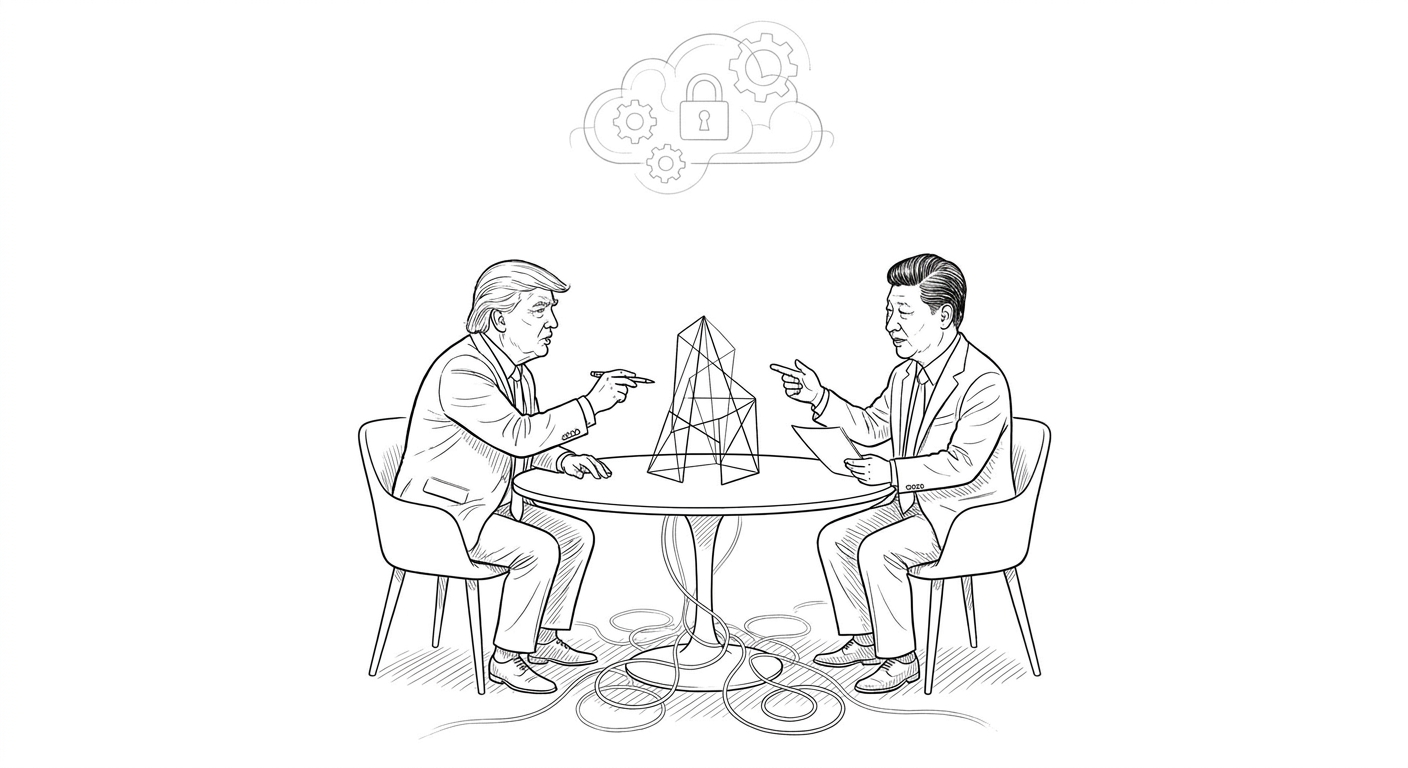
President Donald Trump is expected to raise AI security guardrails with Chinese President Xi Jinping during meetings in Beijing this week, marking a potential shift toward bilateral coordination even as both nations actively develop AI-enabled offensive cyber tools.
The outreach comes as U.S. officials acknowledge that export controls alone cannot contain AI risks and that shared deployment rules may be necessary. "We want to take this opportunity with the leaders meeting to open up a conversation and see if we should establish a channel of communication on AI matters," one U.S. official told reporters. The administration is simultaneously preparing a domestic executive order directing federal agencies to partner with AI companies on cybersecurity threats, though the directive would stop short of mandatory pre-release testing for advanced models.
Former Homeland Security Secretary Alejandro Mayorkas publicly endorsed voluntary federal policies over state-level regulation, warning that "regulations in conflict with one another are not the way industry advances." His comments reflect growing Washington concern over models like Anthropic's Claude Mythos and OpenAI's GPT-5.5-Cyber, which can identify and exploit software vulnerabilities faster than human researchers. Both companies have restricted testing to limited groups including federal agencies and security researchers.
Mayorkas characterized AI tools as having "democratized hacking," enabling more sophisticated cyberattacks at scale. Meanwhile, Google reported finding evidence of AI assistance in an actual cyberattack, lending empirical weight to theoretical warnings about offensive capabilities.
(The National Security Agency is already testing Mythos for potential use in espionage operations, even as Anthropic accused Beijing in November of using Claude to automate parts of a campaign targeting approximately 30 global organizations. The White House last month accused China of running "industrial-scale" campaigns to copy American AI models.)
The diplomatic opening occurs against a backdrop of fundamentally divergent AI strategies. American policymakers prioritize achieving superintelligence through private-sector competition with minimal regulation, while Chinese officials pursue an "AI+" infrastructure approach embedding practical AI tools throughout public services under government coordination. Chinese policymakers largely dismiss near-term superintelligence prospects, instead focusing on diffusion of capable, affordable AI into daily life through initiatives like Hangzhou's City Brain urban management system.
Policy experts caution that substantive cooperation will require technical-level engagement beyond symbolic gestures. "We want to see the technical experts showing up at the table," said one analyst tracking the diplomatic channel. "That's how we'll know that that's actually real." The contradiction of both nations calling for restraint while testing offensive cyber AI capabilities against each other underscores the fragility of any potential agreement.
Dean Ball, a senior fellow at the Foundation for American Innovation and former White House tech policy adviser, acknowledged the regulatory tension: "Some people don't want there to be a regulatory response to this and others do. I don't like regulation. I would prefer for things not to be regulated. But I think we need to in this case."
Keywords
Sources
https://www.axios.com/2026/05/12/trump-china-ai-guardrails-mythos
Focuses on Trump-Xi summit AI discussions and contradiction between calling for restraint while testing offensive cyber AI
https://www.politico.com/news/2026/05/12/mayorkas-ai-voluntary-regulation-00917013
Highlights Mayorkas endorsement of voluntary federal policies over state regulation amid rising cyber model concerns
https://apnews.com/article/google-ai-cybersecurity-exploitation-mythos-926aea7f7dc5e0e61adce3273c55c6d4
Reports Google finding actual evidence of AI-assisted cyberattack and mixed White House signals on oversight
https://www.bloomberg.com/news/articles/2026-05-08/us-prepares-ai-security-order-that-omits-mandatory-model-tests
Details draft executive order on agency-AI company partnerships that stops short of mandatory pre-release testing