White House Accuses China of 'Industrial-Scale' AI Theft Ahead of Trump Summit
Michael Kratsios alleges Chinese entities deploy tens of thousands of proxy accounts to distill U.S. frontier models, threatening chip export policy and bilateral relations.
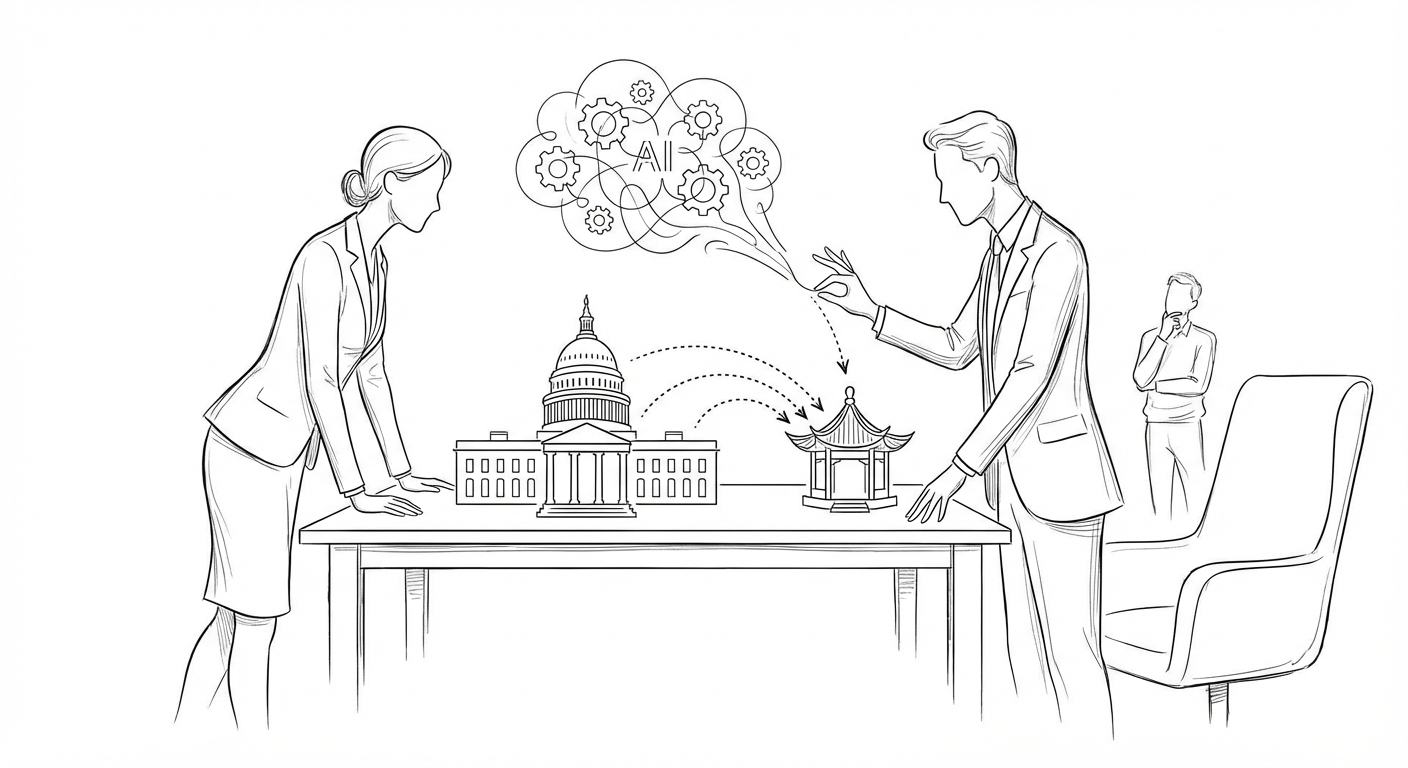
The White House has accused Chinese entities of executing deliberate, industrial-scale campaigns to extract proprietary information from American artificial intelligence systems, escalating tensions ahead of a planned summit between President Donald Trump and Chinese leaders next month.
Michael Kratsios, Director of the White House Office of Science and Technology Policy, wrote in a memo released Thursday that foreign actors, principally based in China, have been deploying tens of thousands of proxy accounts to circumvent safeguards protecting U.S. AI systems. The access enables them to employ "distillation" techniques—training smaller models using the output of larger ones—to surreptitiously replicate advanced American capabilities and release comparable products at a fraction of development costs, according to the memo addressed to government agencies.
The administration said it will share intelligence with American AI companies about the distillation efforts and "explore a range of measures to hold foreign actors accountable." The memo raises immediate questions about whether Washington will permit Nvidia's powerful AI chips to be shipped to China; the Trump administration conditionally approved such sales in January, but Commerce Secretary Howard Lutnick indicated Wednesday that no shipments have yet been made.
Earlier this year, Anthropic identified distillation attacks by three Chinese AI laboratories—DeepSeek, Moonshot, and MiniMax—saying it had found all three working to copy Anthropic models through distillation campaigns. OpenAI has similarly accused DeepSeek of copying its technology. DeepSeek, Moonshot, and MiniMax did not respond to requests for comment from multiple outlets.
(The allegations come as separate Penta Group survey data shows AI use among U.S. federal policymakers has surged to 27 percent who say it informs their perspective on topics, up from 17 percent in 2025, with Republican policymakers 1.2 times more likely than Democrats to use AI daily. The partisan gap could shape how lawmakers ultimately regulate the technology, with implications for governance and competition policy.)
DeepSeek rattled U.S. markets last year when it released a large language model competitive with American AI giants but developed at a claimed cost of only a few million dollars, a fraction of the hundreds of billions being spent by U.S. firms. David Sacks, then serving as President Trump's AI and crypto adviser, suggested at the time that "there's substantial evidence that what DeepSeek did here is they distilled the knowledge out of OpenAI's models." In a February letter to U.S. lawmakers, OpenAI alleged China should not be allowed to advance "autocratic AI" by "appropriating and repackaging American innovation."
Yet the technology transfer can flow in both directions. San Francisco-based startup Anysphere, maker of the popular coding tool Cursor, recently acknowledged that its latest product was based on an open-source model made by Chinese company Moonshot AI, maker of the chatbot Kimi. Kyle Chan, a fellow at The Brookings Institution and an expert on China's technology development, said separating unauthorized distillation from legitimate data requests will be "like looking for needles in an enormous haystack," though information sharing and coordination among U.S. AI labs could help and the federal government can play an important role in facilitating anti-distillation efforts across labs.
Keywords
Sources
https://www.politico.com/newsletters/digital-future-daily/2026/04/24/5-questions-for-jason-droege-00890093
Frames Kratsios memo as part of broader digital policy landscape; includes Jason Droege commentary on state-sponsored AI capabilities
https://www.reuters.com/world/white-house-accuses-china-industrial-scale-theft-ai-technology-ft-reports-2026-04-23/
Emphasizes diplomatic strain ahead of U.S.-China summit and Nvidia chip export policy implications
https://www.bbc.com/news/articles/cpqxgxx9nrqo
Highlights Anthropic's identification of three Chinese labs—DeepSeek, Moonshot, MiniMax—conducting distillation attacks
https://www.greenwichtime.com/business/article/trump-administration-vows-crackdown-on-chinese-22223109.php
Notes bidirectional technology flow, citing Anysphere's Cursor tool built on Moonshot AI's open-source model